
Mohave County Arrest Report Sources
Mohave County publishes no seven-day, weekly, or monthly booking blotter. The Sheriff's inmate-search notice explains why. The public roster tool was turned off to comply with new legal requirements and recent court rulings. Press releases are now the stated route for inmate information. Even so, the release archive functions as a general MCSO publication system. It is not a documented booking ledger.
That leaves the multi-day task to you. Track an event past the same-day window, line up dates and agencies, and then go to the archive or the record custodian. Press releases do not add up to a complete log. A missing name can reflect delay, withholding, a correction, sealing, removal from view, or custody by another agency. It can also mark an event never chosen for a release. Many gaps have ordinary explanations.
The official roster status notice remains on the county site. Read it before assuming a roster exists.
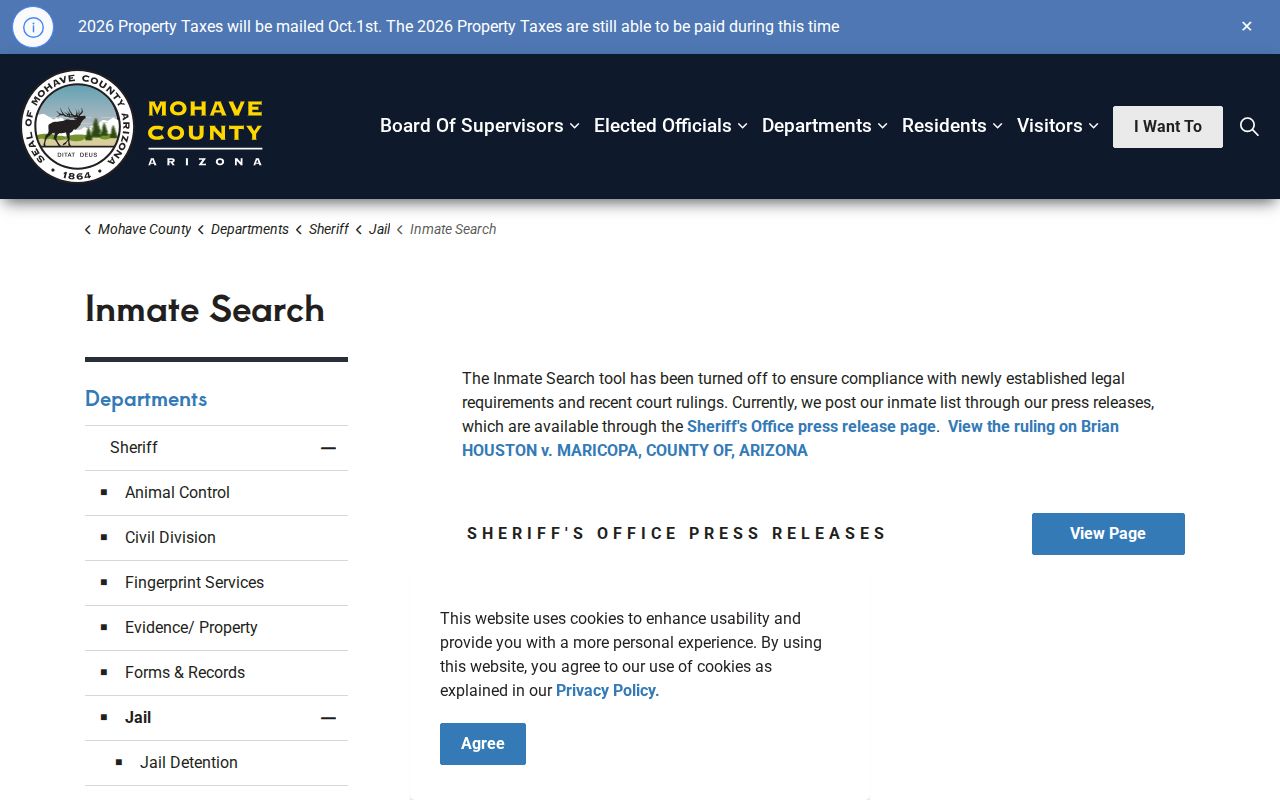
The notice explains the source change but supplies no archive depth or booking-report schedule.
Read Mohave Arrest Reports
Begin with what you already know: the date range, the city, the arresting agency, any name involved, and a case or report number if one exists. Those facts narrow the search. A city police report and a county jail booking record can describe the same event from different points in time. Each office holds its own piece.
- Search the MCSO press-release archive by date and subject where possible. Confirm that the item is from the Sheriff and read the incident date, not only the post date.
- Check a municipal police source when a city agency made the arrest. Lake Havasu City has P2C event searching; Bullhead City and Kingman require more direct records-office routing.
- Identify each record type. The incident report explains police action, the booking record documents intake, and the court docket tracks charges and disposition.
- Use Arizona Public Access or the correct Mohave court for later case status. Court coverage and filing times vary.
- Send a focused written request when the web archive ends before the date needed or lacks the record.
A name alone is a weak match. Compare the agency, the event date, the court, and the case number instead. Keep private identifiers out of anything you publish. Two people can share a near-identical name. Never assume they are the same person.
Note: The posting date may lag the incident date, so search adjacent dates and read the full official item before matching an arrest.
Mohave Blotter Entry Fields
Mohave County has never published a standard field set for a multi-day booking log. An MCSO release shows one slice. A police report shows a different one. Knowing those differences keeps you from mistaking a single page for a full arrest record.
| Possible field | How to interpret it |
|---|---|
| Incident date | When the reported event occurred; it can differ from publication and booking dates. |
| Agency | The police or sheriff office that created the report. |
| Report or event number | A reference for the agency file, not always the court case number. |
| Booking number | A detention intake identifier, if the jail record supplies one. |
| Alleged charge | The charge at that stage. |
| Bond or release | A time-sensitive custody detail that may later change. |
| Court and case number | The path to docket events and final disposition. |
| Photograph | No current public MCSO booking-photo policy was verified. |
A press release is a public-safety notice, not a roster database printout. Expect many fields to be missing. Fill the gaps by requesting the underlying record from its custodian. Assumptions are not a substitute for the file itself.
Mohave Press Releases Are Not Blotters
This distinction matters in Mohave County more than most places. The general archive may hold years of releases. Volume does not equal complete arrest coverage. The county sets no fixed multi-day window, offers no complete-booking guarantee, publishes no update cadence, lists no standard booking fields, and states no retention term for inmate-related posts. The embedded county press-release archive remains open for browsing.
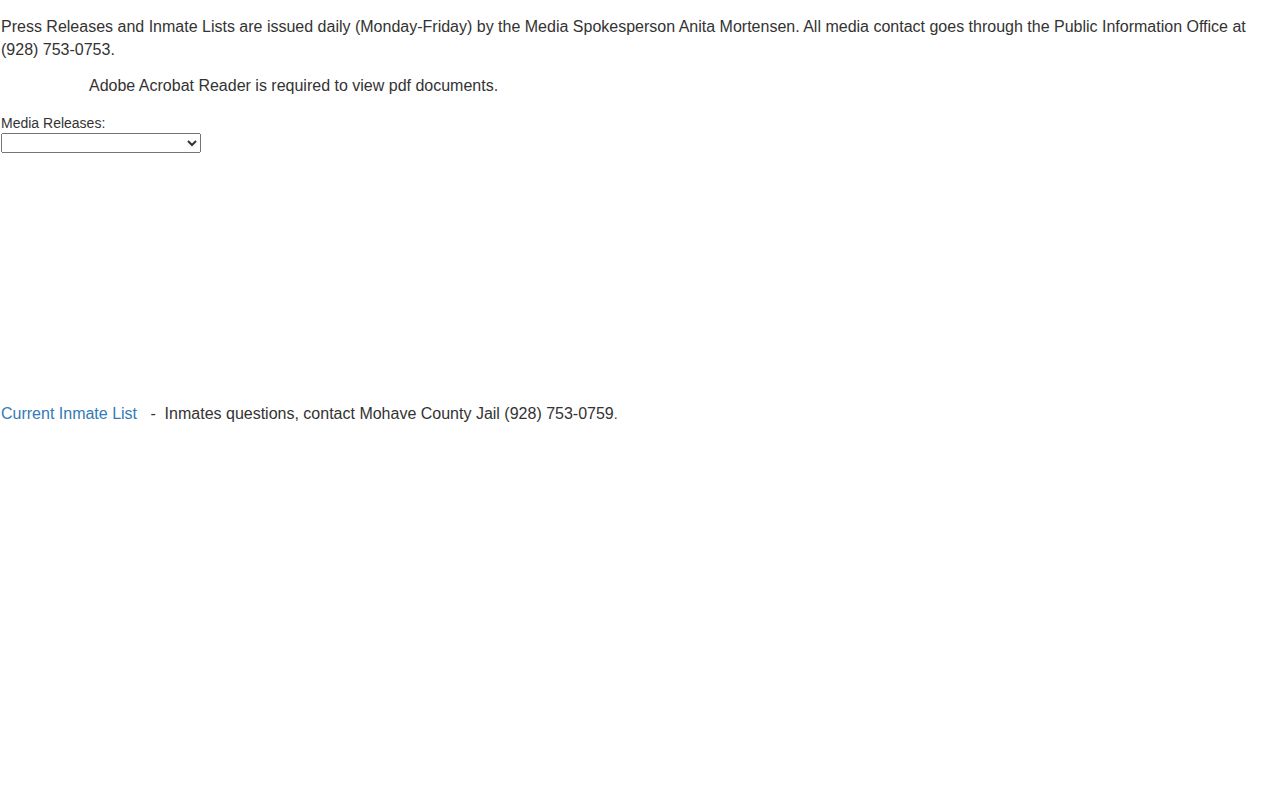
The page displays an archive of Mohave County press releases. It is not a booking roster. Each release covers incidents the sheriff chose to announce. Arrests that went unannounced stay absent.
For fresh bookings, the narrower Arrested Today route checks same-day verification. A multi-day search asks different questions. Does the archive even reach the event date? If not, find the official record that fills the gap.
Weekend Mohave Arrest Reports
MCSO publishes no weekend or holiday schedule. A burst of Monday posts can simply reflect when the agency chose to write, or a processing delay. It does not measure a jump in arrests. A quiet archive proves nothing either, since weekend bookings may have happened without a single post. Court closures add the same wobble, because a police event, a jail record, an initial appearance, and a filed case can each surface on a different day.
Lake Havasu City admits as much. Its P2C guidance notes some events go unreported on the day they happen. The city's daily bulletin helps with municipal events. It cannot establish countywide jail intake. Bullhead City posts records-request channels but no public arrest blotter, and Kingman lists no municipal daily log either. For each city, check the city source first. Then turn to MCSO for county custody and jail records.
Always note two dates. If a news story is your only source, follow its agency attribution and seek the official report or the court file.
News Coverage of Mohave Arrests
Newspaper archives fill in what a custody roster leaves out. An arrest story can name the person, the agency, and the date. That makes it easier to pull an official Mohave County record. The Mohave County Library newspaper page opens the door to the Kingman Daily Miner, Lake Havasu News-Herald, Mohave Valley Daily News, and the Las Vegas Review-Journal through its local and regional resources. Bullhead Laughlin News and KTNV also cover public safety.
Coverage stays spotty. No local outlet runs a full daily gallery of Mohave County mugshots. Search each site by date or agency. Then confirm the arrest with police, the Sheriff, or the court. Old stories linger after charges get dropped or amended.
Unofficial pages go stale too. RecentlyBooked, Mugshots.com, and Arrests.org have carried Mohave material, yet none is an official custody source. Trust the agency's current answer over any of them.
Note: News can point you toward a record, but only the custodian issues the official copy and only the court shows the outcome.
Archive Mohave Arrest Records
A story scrolling off a website does not mean the record itself was destroyed. Arizona State Library retention schedules govern how long law-enforcement and jail material must be kept. The schedules can change. Treat an old schedule as a clue, not a promise. It guarantees neither that a file exists nor that it will be released. Ask MCSO Records which current schedule applies to the named record and date.
Start with the agency that made the file. MCSO Records handles Sheriff reports and county booking records. City police records offices hold municipal reports. A filed case, judgment, or disposition belongs to the Mohave court or clerk. If an office points to an archival transfer, ask about the named accession. Direct that question to the Arizona State Library. State corrections collections exist. Their presence does not prove routine Mohave Sheriff files moved there.
- State the exact person, date range, location, and agency.
- Ask for the incident report, booking record, or other named item rather than “everything.”
- Include known report, booking, warrant, or court numbers.
- Ask the custodian to explain redaction, withholding, fees, and the expected response.
- Keep the request, receipt, response, and any later court order together.
Mohave Records Beyond Jail
Release does not erase a record. A person freed from jail may drop off the custody roster. The incident and court files still remain. Someone transferred after sentencing should be checked through the Arizona Department of Corrections, Rehabilitation and Reentry. ADCRR cautions that release dates and types are not verified or audited. Check offense details in the clerk's file.
Federal custody runs on separate systems. The Federal Bureau of Prisons and ICE cover their own populations, not ordinary Mohave bookings. Sealed records stay out of public search tools. The legal outcome comes from the court, not a blotter line.
When a record looks wrong, ask the source custodian to correct it. Court process handles the rest where it applies. Cached copies can outlive the source page. Dates and final case status matter most.